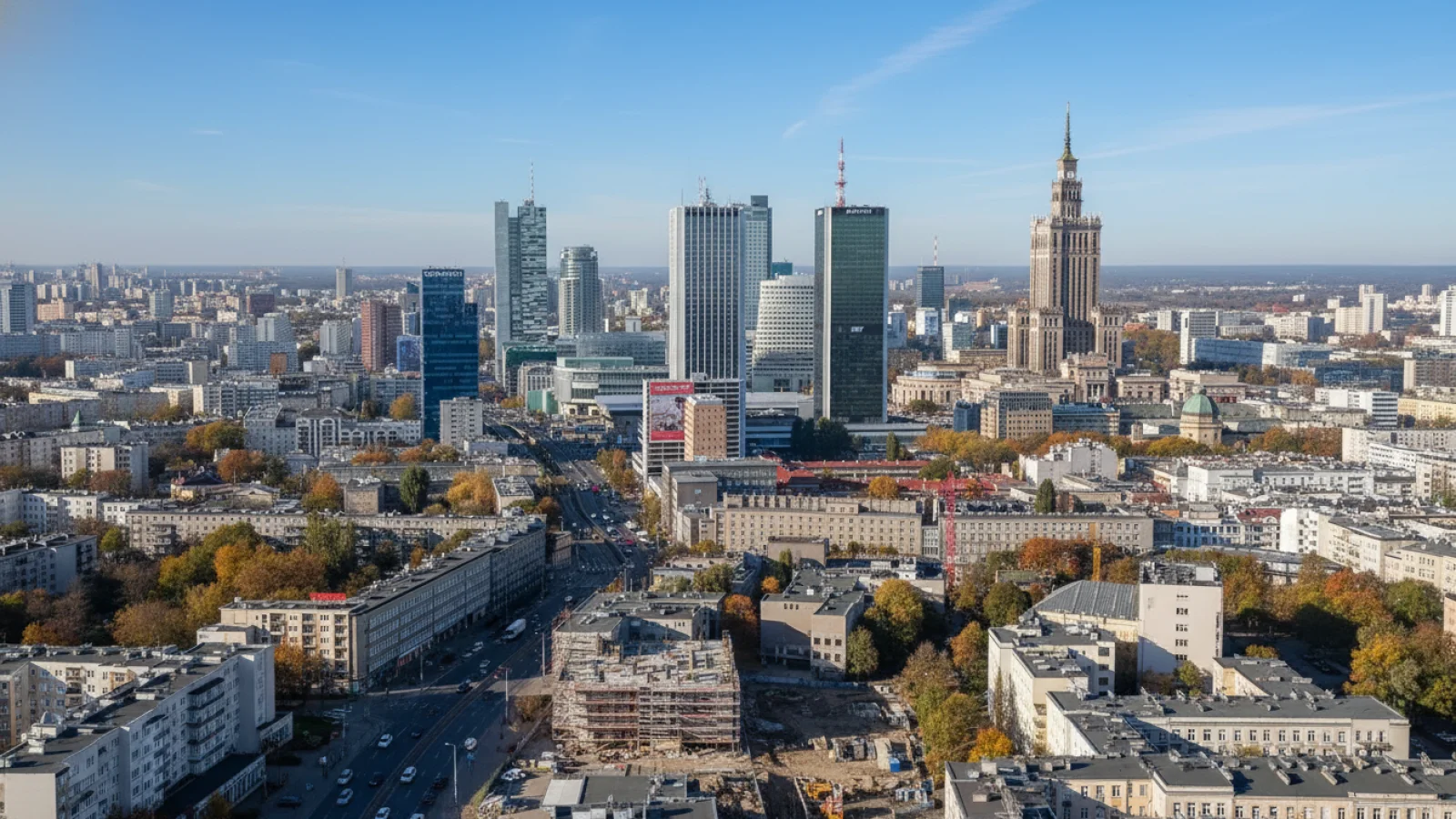
Poland strengthens its position as a key destination amid regional transformation
The beginning of 2025 marks a significant acceleration of investment activity in the Central and Eastern European (CEE) real estate market. Total transaction volume in H1 2025 reached €5.36 billion — up 51% year-on-year — signaling the region’s transition into a more mature and integrated phase. The Czech Republic led in investment volume, while Poland, as the largest CEE market, maintained a strong and stable position. Dynamic growth was also recorded in Slovakia and Hungary.
This report draws on analyses from leading market experts including CEE, Cushman & Wakefield, and EY, providing insight into investment trends, sector performance, and key legal and tax developments in Poland.
Investment Climate and the Rise of Domestic Capital
Poland remains highly attractive to investors thanks to solid economic fundamentals. GDP grew by 3.4% y/y in Q2 2025, with the same growth projected for 2025–2026. Poland ranks sixth in the EY European Attractiveness Survey 2024, reflecting strong investor confidence.
Investment transactions in Poland reached €1.71 billion in H1 2025, with the full-year total expected to exceed €4 billion. Activity is forecast to accelerate in the second half of the year.
A major trend is the growing share of domestic capital — Polish investors accounted for 40% of office sector transactions. This indicates greater professionalism and confidence among local players acquiring high-quality assets in both metropolitan and regional markets, highlighting CEE’s maturing profile.
Sector Insights
1. Office Sector: Supply Shortage and Quality Focus
Office transactions totaled around €400 million in H1 2025. Investment activity concentrates on centrally located, high-quality assets, where limited new supply is driving a persistent shortage.
Warsaw saw 85,200 m² of new completions (up 34% y/y), though development activity remains moderate. Vacancy rates are falling, particularly in prime central buildings, while rental growth focuses on top locations.
The hybrid work model has become permanent, yet companies increasingly encourage office returns. Demand for flexible coworking space continues to rise. Warsaw’s office market also plays a key role in Poland’s pharmaceutical industry, hosting nearly half of all pharma companies.
2. Industrial & Logistics: Stability and Doubled Investments
The warehouse sector remains resilient, with transaction value reaching €694 million in H1 2025 — more than double last year’s figure — including the first portfolio deal exceeding €100 million.
New supply totaled 1.15 million m² (-26% y/y), while vacancy stood at 8.2%. Demand for city logistics and nearshoring remains strong, though limited land availability and lengthy permitting hinder new development.
3. Retail & Hospitality: Anticipating Recovery
Retail transaction volumes fell 35% below the five-year average but are expected to recover in H2 2025, driven by a record pipeline of retail parks and mixed-use developments. Key trends include hybrid shopping, AI-driven customer service, and social commerce.
The hotel sector continues its post-pandemic recovery. Poland ranked second in the CEE region by hotel transaction volume. International tourist arrivals rose 7%, and hotel occupancy increased 3% y/y. Warsaw hotels achieved record occupancy and room supply, with several new brands scheduled to open.
4. Residential Sector: PRS Growth and New Housing Programs
Residential price growth is expected to slow, yet new-home sales may rise 10–15% y/y.
The new government program “Key to the Apartment” aims to improve affordability for middle- and lower-income buyers, potentially affecting the secondary market, particularly in smaller cities.
The Private Rental Sector (PRS) remains under 1% of total rental stock but is expanding rapidly. Investors are increasingly converting commercial assets — offices and retail — into rental housing and student accommodation.
Regulatory and ESG Changes: Shaping the Market’s Future
ESG and Sustainability: Buildings account for 40% of EU energy use and 36% of CO₂ emissions. ESG compliance is now a decisive factor in financing, as banks prioritize “green” loan portfolios. The number of ESG-certified buildings in Poland grew 24% in 2024. From 2028, all new buildings over 1,000 m² must undergo carbon-footprint assessment.
Legal and Tax Updates: Effective January 1, 2025, significant amendments to the Real Estate Tax (RET) introduced independent definitions of buildings and structures, which may increase tax burdens. Urban planning reform is planned for 2026, requiring new municipal master plans to enhance transparency and investment efficiency. Work also continues on regulating Polish REITs (SINN), with a draft expected later in 2025.
Technology (PropTech and AI): PropTech and AI adoption is transforming real estate — streamlining ownership, construction, and management. Embracing these technologies will be essential for property owners and users to remain competitive in 2025 and beyond.