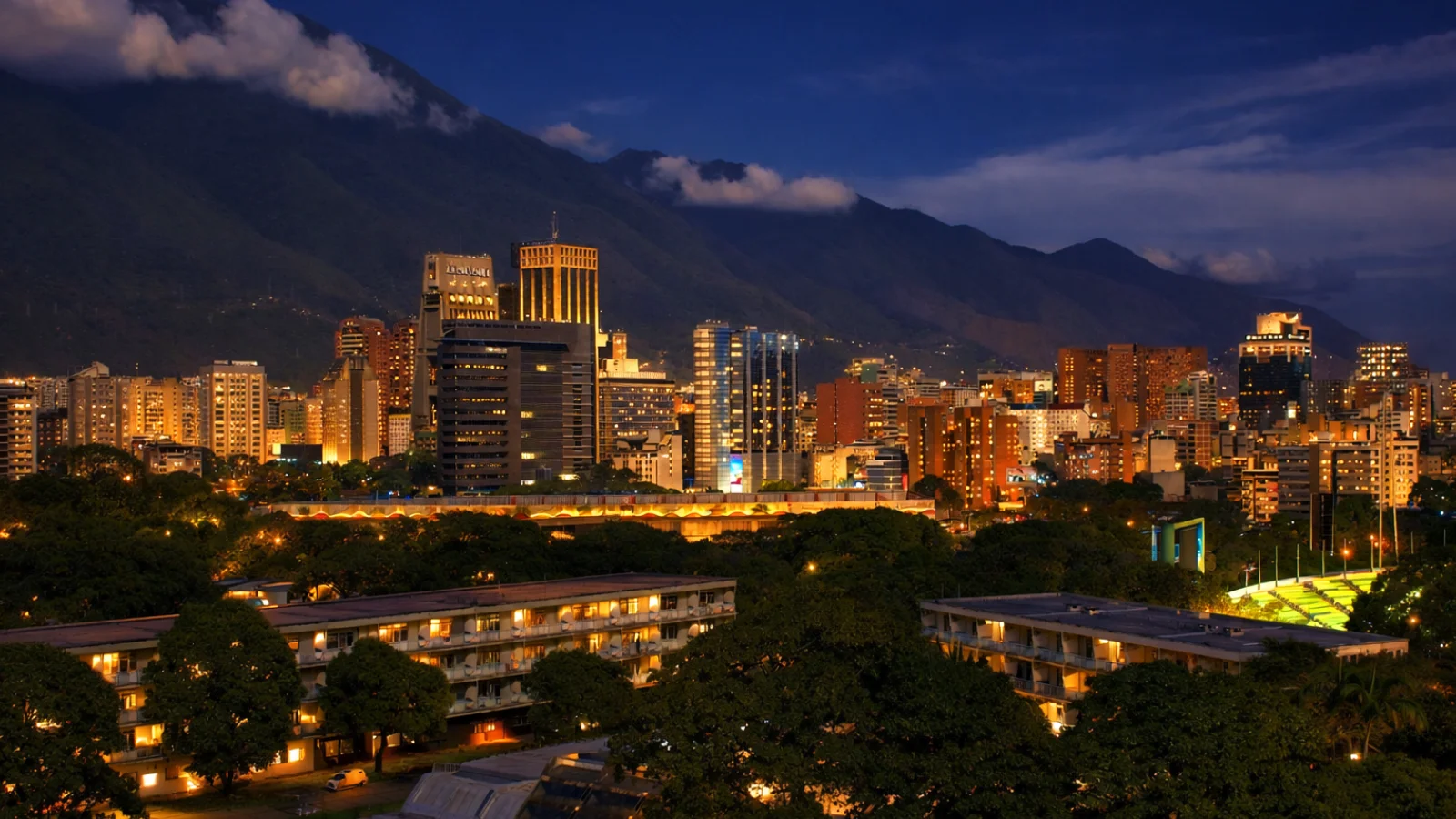
This report is a scenario-based market analysis built on the assumption of a full political regime transition in Venezuela in early 2026. All projections, valuations, and risk models should be read within this analytical framework.
Venezuela’s real estate market in 2013–2025 evolved into a rare anomaly: a countrywide collapse in valuation fundamentals paired with a narrow, dollarized premium bubble in parts of Caracas. A real GDP contraction of over 75% (2013–2021) and the breakdown of credit transformed real estate into an almost entirely cash-equity market, while infrastructure failure turned “autonomy” (water, power, connectivity) into a decisive pricing factor. Meanwhile, mass emigration—approximately 7.7 million people—left behind a large “ghost inventory” of underused homes and commercial space, much of it frozen by legal risk, informal occupancy, or simple illiquidity. Settlement rails shifted to USD cash and USDT (Tether) as workarounds to banking dysfunction and sanctions friction, creating fast execution but weak legal/tax traceability.
What matters for investors in the transition phase:
- Liquidity initially worsens (title disputes, restitution claims, institutional reset), even if sentiment improves.
- Premium micro-markets can recover faster under de facto dollarization, but only where security + autonomy are credible.
- Title and possession risk dominate price discovery: documentation alone is insufficient without physical verification and registry certainty.
- Early visibility matters. In the first phase of price discovery, even partial market views help benchmark asking prices and track new supply as it appears. Agentiz is building its Venezuela coverage as an early-stage listings feed (local owners and agencies can publish and shape the dataset): Agentiz – Venezuela
The Macroeconomic Abyss: Contextualizing the Real Estate Collapse
The Magnitude of Economic Destruction
To evaluate Venezuelan real estate prior to transition, the starting point is the macro collapse. Between 2013 and 2021, Venezuela’s real GDP contracted by more than 75%—a decline comparable in magnitude to the most severe modern economic breakdowns, including some conflict-affected economies, despite the absence of nationwide conventional war. [1]
A central driver was the oil sector’s collapse. Production that averaged roughly 2.8 mbpd (2008–2013) fell to roughly 0.4 mbpd by mid-2020, reflecting chronic underinvestment, loss of technical capacity, and politicized management. [8] The resulting fiscal crisis accelerated monetary financing and hyperinflation, effectively destroying the Bolivar as a stable unit for pricing long-lived assets.
The monetary breakdown eliminated the mechanics that typically support housing markets:
- Mortgage credit disappeared. Banks could not sustainably lend in rapidly devaluing currency, and credible long-tenor lending ceased. (This is reflected in the broader collapse of financial intermediation and lending conditions.) [4]
- Spontaneous dollarization emerged. By 2019, much of the market quoted in USD, even where formal policy and administrative practice remained ambiguous. [1]
Infrastructure Failure as a Valuation Cap
Real estate utility depends on the grid. As electricity, water, and telecom reliability collapsed, valuation began to incorporate “survival utility.” Buildings with deep water wells (pozos), industrial-grade generators, and resilient connectivity traded at a premium; those dependent on public services faced structural discounts. This created a tiered market where “autonomy” displaced traditional luxury metrics.
The Demographics of Abandonment and “Ghost Inventory”
Emigration reshaped supply and demand. By 2022–2023 estimates, around 7.7 million Venezuelans had left the country, hollowing out the consumer base that normally sustains middle-market housing demand and maintenance. [2]
A large share of properties did not clear at distressed prices because owners were unwilling to crystallize losses or hoped for eventual recovery. The result was illiquid “ghost inventory”: underused homes plus surplus office/industrial stock in key cities—supply that existed physically but did not behave like normal market supply due to legal and possession risk, administrative friction, and the diaspora’s inertia.
The Distorted Market: A Tale of Two Venezuelas
The Caracas Premium Bubble: Concrete as a Store of Value
In parts of Caracas (notably Las Mercedes / Chacao), construction and pricing diverged from national fundamentals. The bubble was not driven by broad-based income growth or mortgage expansion; it was driven by (a) capital preservation under dollarization and (b) suspected illicit finance seeking a local store-of-value in hard assets. [12]
Pricing could remain high because many holders prioritized preservation/opacity over liquidity. Occupancy rates and yields were often secondary, producing a “balance-sheet city” dynamic: buildings as stores of value, not necessarily productive assets.
The Middle-Class and Interior Depression
Outside the premium bubble, values collapsed. With no functioning mortgage market, transactions required near-total cash, shrinking the buyer base. Infrastructure and condo maintenance failures accelerated physical decay, pushing values down further in older middle-class towers and interior cities. Construction sector weakness reinforced the negative loop: deterioration outpaced refurbishment capacity. [3]
The Financial Rails of a Pariah Market
Why Crypto Became a Settlement Layer
When domestic banking is fragile and cross-border wiring is constrained, settlement shifts to whatever clears. In high-end and cross-border cases, USDT increasingly functioned as a practical settlement layer: fast execution, low friction, and global convertibility. However, it also introduced counterparty and compliance risk (freezes, AML/KYC exposure, weak legal enforceability).
Micro-Case 1: A USDT Transaction in Chacao
Context: A buyer and seller agree on a $75,000 apartment sale in Chacao.
Constraint: Large cash delivery is a security risk; standard cross-border settlement is unreliable/slow and vulnerable to compliance friction.
Mechanics: Parties settle 75,000 USDT wallet-to-wallet, then sign a public deed that acknowledges payment “prior to this act” (a common euphemism to avoid operational friction when registrars lack clear frameworks).
Risk: If funds are delayed/frozen, or if the transaction later requires tax substantiation, remedies are limited and dispute resolution is weak.
Investor takeaway: Crypto can reduce settlement friction, but it increases the value of disciplined documentation, escrow structuring, and clean provenance.
Legal Purgatory: Property Rights Under Chavismo
SUNAVI and the Anti-Eviction Regime
A core deterrent to investment was the systematic weakening of enforceable property rights in practice. Housing lease controls and eviction constraints—reinforced through administrative and judicial bottlenecks—made standard landlord remedies unreliable, increasing the perceived “tenant lock-in” risk. [6]
This pushed rentals into semi-informal structures: heavy upfront payments, corporate-style contracts where possible, and preference for trusted networks.
SAREN: Registry Friction, Corruption Risk, and Parallel Ownership
Registry and notary processes became a high-friction layer where delays and informal intermediaries (“gestores”) were often necessary. [5] In parallel, some transfers relied on private documents notarized for signature recognition but not fully registered, creating a shadow layer where possession and “paper ownership” diverged—an obvious fault line for future disputes. [14]
Micro-Case 2: The Caretaker Dilemma (“Cuidador” Risk)
Context: A diaspora family leaves a home under an informal caretaker arrangement to prevent invasion/squatting. Conflict: Years later, the caretaker refuses to vacate, leveraging the ambiguity of employment/occupancy status and the slow system to demand a settlement. Outcome: The owner often faces a choice: pay to regain control or enter a long, uncertain dispute.
Investor takeaway: Possession risk is not theoretical; it is a pricing variable. “Occupied” can mean “encumbered,” even without a formal lease.
The Human Layer: Migration, Remittances, and “People as Infrastructure”
Diaspora as Absentee Owners
With millions abroad, caretakers became operational infrastructure—managing water deliveries, repairs, security, and local political frictions. This kept assets from collapsing completely but created hostage-style risk when relationships were informal.
Remittances as Decentralized Maintenance Capital
Remittances emerged as a key stabilization flow, funding “survival upgrades” (tanks, security, connectivity) that preserved habitability more than market value. This suggests early reconstruction at the household level may remain decentralized, even before institutional capital returns. [13]
GMVV and the Politicization of Housing
State-led housing programs affected urban geography and neighborhood dynamics. Where quality, services, and planning lagged, spillover effects could depress surrounding values and reinforce the narrative of housing as political allocation rather than stable private property. [15]
Comparative History: What Transitions Usually Do to Real Estate
Nicaragua (1990): The Legal Hangover
Post-transition Nicaragua illustrates how restitution claims and disputed titles can freeze liquidity for years. Even when political change arrives, real estate may remain depressed until dispute resolution mechanisms mature. [10]
Panama (Post-1989): Dollarized Recovery Dynamics
Panama’s experience shows how dollarization can accelerate premium-segment recovery once security and institutional credibility stabilize—especially in services-driven hubs. Venezuela’s de facto dollarization could support a similar mechanism in select zones, but only if infrastructure and legal certainty improve. [11]
Transition Roadmap and Scenarios
A Reform Template: “Plan País”
Reconstruction blueprints emphasize:
- Restoring property rights (restitution/compensation mechanisms)
- Infrastructure investment (grid and water first)
- Privatization and institutional reset (to re-enable investment and credit) [9]
Mortgage Credit: The Medium-Term Unlock
The most transformative shift for the middle market would be the return of mortgage lending. Even expensive credit would expand demand elasticity in the $30k–$100k segment, which has been structurally depressed by cash-only constraints. This is contingent on monetary stability and bank re-capitalization.
Scenario Framework (2026–2030)
| Scenario | Probability | Core Features | Real Estate Implications | Early Indicators to Watch |
|---|---|---|---|---|
| Rapid Normalization | Low | Sanctions relief + credible institutions + infrastructure push | Premium Caracas and tourism corridors rebound; formal rental market returns; construction restarts selectively | Clear restitution framework; grid upgrades funded; credible registry reforms |
| Stalled Transition | High | Political fragmentation + slow legal cleanup | Two-speed market: secure/autonomous zones outperform; broad market illiquid; gradual recovery | Persistent registry delays; limited credit; security enclaves dominate |
| Elite Capture Continuity | Medium | Asset transfers consolidate to a new insider class | High-end stays elevated but detached; title/possession risk remains; mid-market decays | Opaque privatizations; weak enforcement; selective protection for insiders |
Strategic Investment Outlook & Conclusion
Investment Thesis (Practical, Not Romantic)
Venezuela can be “cheap” and still be a trap. The risk premium is real and often unpriceable without field verification.
Prefer (risk-managed upside):
- Industrial/logistics assets near major corridors and ports (import flows, reconstruction supply chains).
- Prime-but-aged residential in historically stable neighborhoods if autonomy/security can be engineered cost-effectively.
- Distressed hospitality only with clear possession, clean chain-of-title, and a realistic rehab plan.
Avoid (as a default posture):
- Pre-construction luxury where provenance of capital, occupancy assumptions, and legal exposure are unclear.
- Anything with ambiguous possession (caretakers, informal occupants) unless discounted enough to fund resolution.
Investor Summary (Action Layer)
Where the money is most likely to be:
- Logistics/warehousing tied to reconstruction flows and energy supply chains
- Secure, autonomy-ready rentals for returning professionals in limited micro-markets
- Select distressed tourism assets with clean legal foundations
Where the risk concentrates:
- Title risk (unregistered transfers, contested registry entries, future restitution claims)
- Possession risk (caretakers/squatters/informal occupants)
- Infrastructure risk (assets priced as “luxury” but dependent on broken grids)
- Compliance risk (sanctions friction; AML/KYC exposure in payment rails)
Minimum viable due diligence checklist:
- Verify physical occupancy and control, not just paper title
- Reconstruct chain-of-title with emphasis on registry registration, not private papers
- Budget autonomy upgrades (water/power/connectivity) as capex, not “nice to have”
- Use structured escrow + clean-funds provenance for any crypto-adjacent settlement
- Treat early-stage transition pricing as price discovery, not equilibrium
Venezuelan real estate in the transition frame is a market where the pricing of assets depends less on finishes and more on enforceability—security, autonomy, registry credibility, and institutional traction. Early winners are those who can reduce uncertainty, not those who chase low nominal prices. If institutions stabilize and infrastructure is rebuilt, the recovery can be powerful—but it will be uneven, slow to normalize, and highly sensitive to legal clarity.
For ongoing price discovery and new supply tracking during the transition, follow the early Venezuela listings feed on Agentiz: https://ve.agentiz.com/en
Agentiz (global directory): https://www.agentiz.com/en
Sources
- 1. Economics Observatory — “Why did Venezuela's economy collapse?”
- 2. IMF eLibrary — “The Venezuelan Exodus: An Unprecedented Economic and Humanitarian Crisis”
- 3. Caracas Chronicles — “Venezuelan Construction Shrank 98% Since 2012”
- 4. CEIC Data — Venezuela lending / financial conditions
- 5. Transparencia Venezuela (en el exilio) — Extortion / institutional fragility report
- 6. R4V — Guidance Note on eviction risks for refugees/migrants
- 7. Justia Venezuela — Ley Orgánica del Trabajo (LOTTT) text
- 8. Chatham House — Reforming Venezuela’s oil and gas sector
- 9. Atlantic Council — Plan País (roadmap / event recap)
- 10. U.S. State Department FOIA doc — Nicaragua property claims / post-conflict restitution
- 11. IMF Staff Country Reports — Panama growth and recovery context
- 12. U.S. Department of the Treasury — National Money Laundering Risk Assessment (real estate risk framing)
- 13. The Dialogue — Venezuela remittances as survival FX / economic lifeline
- 14. Academic/legal analysis on signature recognition vs registry vulnerability
- 15. Architecture & Politics — GMVV “Only a Facade” analysis